



An ACH payment can fail after a merchant initiates it. When that happens, the customer’s bank sends the payment back with a short reason. That reason is an ACH return code. Each code starts with the letter R and has two digits, such as R01 or R03.
Merchants that accept bank payments can find these codes in their payment processor dashboards or bank reports. Each code explains why the payment was returned, the applicable return window, and whether the merchant can submit a corrected or reinitiated payment.
ACH Return Codes List
The table covers commonly encountered ACH return codes, their return windows, and the actions merchants can take.
| Code | Reason | Return Window | Can Merchants Retry? |
|---|---|---|---|
| R01 | Insufficient Funds. | 2 Banking days | Yes, up to two times. |
| R02 | Accounts Closed. | 2 Banking days | Only with a new account and authorization. |
| R03 | No Account/ Unable to Locate Account. | 2 Banking days | After the account number is corrected. |
| R04 | Invalid Account Number Structure. | 2 Banking days | After the account number is corrected. |
| R05 | Unauthorized Debit to Consumer Account Using Corporate SEC Code. | 60 Calendar days | Only with proper consumer authorization under the correct SEC code. |
| R07 | Authorization Revoked by Customer | 60 Calendar days | No, without new authorization. |
| R08 | Payment Stopped. | 2 Banking days | Only with new authorization. |
| R09 | Uncollected Funds. | 2 Banking days | Yes, only up to two times. |
| R10 | Customer Advises Not Authorized. | 60 Calendar days | New authorization needed. |
| R11 | Entry Not in Accordance with the Authorization. | 60 Calendar days | Only to fix the error. |
| R16 | Account Frozen/ Entry Returned per OFAC Instruction. | 2 Banking days | No |
| R20 | Non-Transaction Account. | 2 Banking days | Confirm with the merchant’s bank. |
| R29 | Corporate Customer Advises Not Authorized | 2 Banking days | No |
Note: Return windows are generally measured from the settlement date of the original entry. Extended return rights and applicable deadlines depend on the transaction type and ACH rules.
ACH Return Code Descriptions
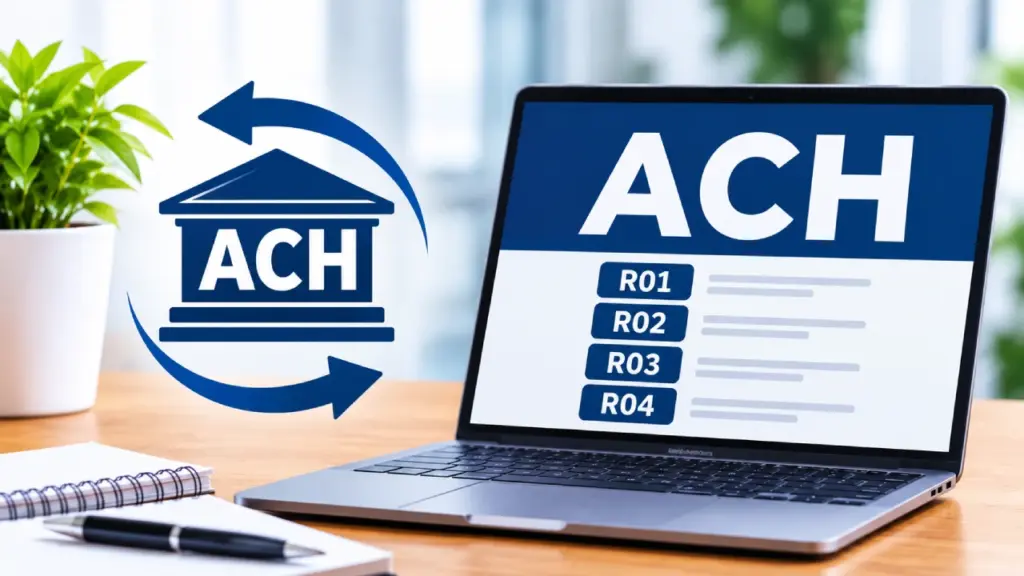
Two banks handle every ACH debit. The merchant’s bank sends the payment. The customer’s bank receives it and may return it. The customer’s bank picks from a fixed list of ACH return reason codes and chooses the one that fits the problem.
Return windows fall into two groups. Most codes for account problems, such as R01 through R04, must arrive within two banking days. Codes for unauthorized debits, such as R05, R07, R10, and R11, can arrive up to 60 calendar days later.
Common ACH Return Codes
Many failed ACH payments come from a small set of causes: low balances, closed accounts, and wrong account details. Of all the ACH return reason codes, a handful cover these causes, and the R03 is the standard example of a wrong account number. The sections below cover each one.
ACH R01 Insufficient Funds
An R01 ACH return code means the customer’s account did not hold enough money. Merchants can send the debit again. Nacha limits a merchant to two retries, and one bank guide says the retry must happen within 180 days of the original settlement date. R09, Uncollected Funds, follows the same limits. It appears when the account’s ledger balance is sufficient, but the available balance is not.
A retry must keep the original company name, company ID, and amount. The entry description should read “RETRY PYMT” so the customer’s bank can spot the retry.
ACH R02 Account Closed
An ACH return code R02 shows that the customer closed the account. Sending the debit again will fail. A merchant who gets the R02 ACH return code should ask the customer for a new account and get fresh authorization for it.
ACH R03 No Account or Unable to Locate Account
An ACH return code R03 means the bank cannot find an account that matches the number sent. A typing mistake is the usual cause. Merchants who see the R03 ACH return code should check the number with the customer and correct it before starting a new entry.
A second try with the same number returns the same R03 ACH return code, so the account details must change before the merchant sends another debit.
ACH Return Code R04 and R20
The ACH return code R04 means the account number has an invalid structure. A failed check digit or the wrong number of digits can cause it. The fix matches the R03 return code fix. With the R04 code, the merchant confirms the number and then sends a new entry.
Return code R20 points to a non-transaction account. The R20 ACH return code applies to entries sent to a non-transaction account, such as certain savings or money market accounts.
ACH R16 Account Frozen
A frozen account, or an entry returned under an OFAC instruction, produces the R16 ACH return code. Nacha prohibits reinitiation after R16, so the merchant cannot send the debit again. The R16 code usually calls for a conversation with the merchant’s bank, since the freeze may come from a legal action.
Unauthorized ACH Return Codes
Among ACH return reason codes, the unauthorized ones carry the most risk for merchants, since they count toward Nacha’s strictest limit.
- R05: A corporate-coded debit hit a consumer account without authorization.
- R07: The customer revoked the authorization. The merchant should not reinitiate without new authorization.
- R10: The customer says the merchant is not known to them or had no authorization to debit the account. It applies to unauthorized consumer debits and to any international ACH debit. A retry needs new authorization.
- R11: The customer claims that the entry did not comply with the terms of the authorization, such as an incorrect amount or payment date. Merchants may submit a corrected entry without obtaining new authorization when the original authorization remains valid, and the underlying error is corrected.
- R29: A business customer says the debit was not authorized. The R29 ACH return code applies to corporate entries, and the merchant cannot retry it. It must arrive within two banking days.
For R05, R07, R10, and R11, the customer’s bank must first collect a signed Written Statement of Unauthorized Debit from the account holder.
Regulation E works separately from Nacha’s return window. Under Regulation E, a consumer must tell the bank about an unauthorized transfer within 60 days of the date the statement showing it was sent. Nacha’s 60-day return window instead runs from the settlement date of the original entry. The bank generally has 10 business days to decide if an error occurred, or up to 45 days if it credits the consumer’s account in the meantime. Longer periods (20 business days and 90 days) apply in some cases, such as new accounts and foreign transactions.
NACHA ACH Return Codes and Return Rate Limits

Nacha, the group that writes ACH rules, watches how often a merchant’s payments come back. Three limits apply:
| Rate | Limit | Codes Counted |
|---|---|---|
| Unauthorized | 0.5% | R05, R07, R10, R11, R29, R51 |
| Administrative | 3% | R02, R03, R04 |
| Overall | 15% | All returned debit entries (RCK entries excluded) |
The ACH return code R03 counts toward the 3% administrative limit, along with R02 and R04. Nacha calculates the rate over the previous 60 days or two calendar months. For example, 500 returned debits out of 100,000 sent gives a 0.5% rate.
A merchant who passes a limit can face a Nacha inquiry through the merchant’s bank. If the unauthorized rate is above 0.5%, the bank must submit a plan to bring it down within 30 days. For the administrative and overall levels, a Nacha panel can direct the bank to cut the rate within 30 days. Nacha then monitors it for another 180 days. Banks that fail can face fines.
How Nacha Calculates ACH Return Rates
Nacha generally evaluates return activity over the preceding 60 days or two calendar months.
As an example of the overall return rate, suppose a merchant originates 100,000 ACH debit entries and receives 500 returns during the applicable measurement period.
The overall return rate would be:
500 ÷ 100,000 × 100 = 0.5%
Merchants should monitor each return category separately, since the unauthorized, administrative, and overall rates are each calculated on their own and carry different reporting requirements.
Financial institutions may also impose stricter internal thresholds and monitoring requirements.
Returned Payments: Notifications and Dishonored Returns
A notification of change is not a return. It tells the merchant that account details need updating, with codes such as C01 for the account number, C02 for the routing number, and C03 for both. The merchant must make the change within six banking days, or before sending another entry, whichever is later.
A dishonored return challenges a return that broke the rules, such as a late or misrouted one. The merchant’s bank has five banking days to dishonor a return. The customer’s bank then has two banking days to contest or correct that dishonor. Dishonored returns use codes R61 through R70, and contested ones use R71 through R77.
How to Cut ACH Returns
Merchants can lower their return counts with four steps.
- Check the account and routing numbers before the first debit, since an ACH return code R03 or R04 comes from bad details.
- Act on every notification of change within six banking days.
- Retry R01 and R09 payments no more than twice. Resubmit other returned payments only after the underlying problem is fixed or new authorization is on file.
- Keep the customer’s authorization on file, since R10 returns depend on it.
ACH return reason codes explain why a bank payment failed and what the merchant can do next. Account-error codes such as ACH return code R03 return within two banking days. Unauthorized codes such as R10 can return up to 60 days later and count toward Nacha’s strict 0.5% limit. Merchants who track their return codes by category can spot trouble early and keep their return rates in range.
Frequently Asked Question
They are short codes, such as R01 or R03, that explain why a bank sent an ACH payment back.
Most account-error returns arrive within two banking days. Unauthorized returns can arrive within 60 calendar days.
Yes for R01 and R09, up to two times. R08 and R10 need new authorization, R03 and R04 need corrected account details, and R02 needs a new account with fresh authorization. R16, R20, and R29 cannot be retried.
R10 covers consumer accounts and international ACH debits, and R29 covers business accounts. A merchant cannot retry R29, and R10 needs new authorization.
Unauthorized returns must stay at or below 0.5%, administrative returns at or below 3%, and returned debits overall at or below 15%.
The merchant should correct the account number with the customer before sending a new entry. A repeat debit with the same details brings back the R03 ACH return code.



Join the conversation
Have something to add? Share your thoughts below.