


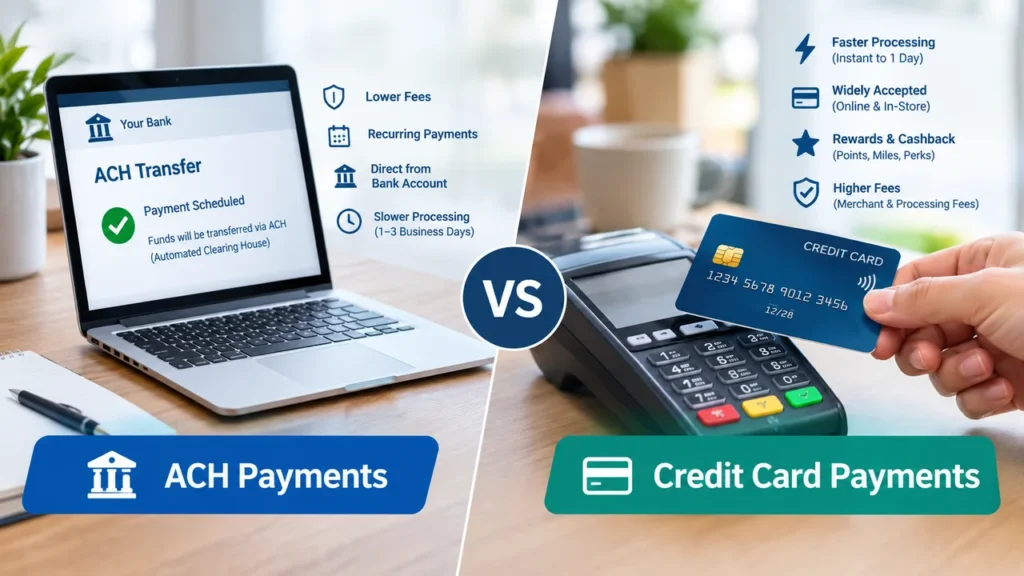
While both ACH and Credit Card payments allow businesses to collect payments electronically, they differ significantly in terms of processing costs, transaction speed, settlement times, security features, and dispute procedures. ACH payments transfer funds directly between bank accounts and are generally more cost-effective, particularly for recurring or high-value transactions. Credit card payments, on the other hand, offer faster authorization, greater convenience, and established consumer protections, making them particularly suitable for retail and e-commerce transactions.
What Is ACH?
ACH stands for Automated Clearing House, a network that moves money electronically between U.S. bank accounts. An ACH payment pulls funds directly from a customer’s checking or savings account and deposits them into the business’s account, without a card or card network involved at any point.
ACH transactions are processed in batches rather than individually in real time, which is the reason they take longer to settle than a card payment. A typical transfer takes one to three business days to complete, though same-day ACH processing options exist for an added fee. As ACH runs on bank account details rather than card numbers, it’s commonly used for recurring bills, payroll, rent, B2B invoices, and other payments where the parties already have an established relationship.
What Is a Credit Card Payment?
A credit card payment routes a transaction through a card network, such as Visa, Mastercard, Discover, or American Express, which communicates with the cardholder’s issuing bank to approve or decline the charge. Authorization happens in seconds, giving both the customer and the business an almost immediate answer on whether the payment went through.
Even though authorization is instant, the actual funds typically take one to two business days to settle into the business’s account. What differs is the fee structure and the layers of protection built into the process: accepting credit card payments carries interchange fees set by the card networks, along with dispute and chargeback rights that give cardholders a built-in way to reverse a transaction they believe was fraudulent or incorrect.
ACH vs. Credit Card Transaction Comparison
ACH and credit card payments both provide convenient ways for businesses to collect payments electronically, but they differ in how transactions are processed, how quickly funds settle, what they cost, and how disputes are handled.
| Features | ACH Payment | Credit Card Payment |
|---|---|---|
| How it works | Direct bank-to-bank transfer. | Routed through a card network and issuing bank. |
| Settlement time | 1-3 business days (same-day option available). | Authorization is instant; funds settle in 1-2 business days. |
| Typical cost to business | Flat fee or low percentage, often under 1%. | Percentage-based, commonly 1.5% to 3.5% per transaction. |
| Chargeback/dispute process | Returns possible; consumers can typically dispute an unauthorized debit for up to 60 days, though the process and timelines are less standardized than card chargebacks. | Formal chargeback process built into card networks. |
| Common use cases | Recurring bills, payroll, B2B invoices, rent. | Retail, e-commerce, one-time consumer purchases. |
| Setup requirement | Bank account and routing number, or a bank-linking tool. | Card number, expiration date, and security code. |
| Failure risk | Insufficient funds, closed account, incorrect details. | Declined card, expired card, fraud flag |
ACH Payment Advantages and Disadvantages
ACH payments have both pros and cons, and business owners should weigh them before adopting it.
Advantages:
- Lower processing costs: ACH fees are typically much lower than card processing fees, especially for larger transaction amounts, since the cost isn’t usually calculated as a percentage the way card fees are.
- Well-suited to recurring payments: Once a customer authorizes it, ACH works well for subscriptions, memberships, and invoices that repeat on a predictable schedule.
- Lower cost on large transactions: Since ACH fees aren’t percentage-based, businesses avoid the rising dollar cost that comes with card fees as transaction size grows.
- No card network fees: Bypassing the card networks entirely removes the interchange and assessment fees that make up a large share of credit card processing costs.
Disadvantages:
- Slower settlement: Waiting one to three business days for funds to clear is a real drawback for businesses that need faster access to revenue.
- Higher failure rate for new relationships: Entering a bank account and routing number correctly matters more than swiping a card, and errors or insufficient funds can delay or fail a transaction.
- Return and dispute rules are less standardized: ACH returns exist for unauthorized transactions, but the process and timelines differ from the formal, well-defined chargeback prevention that comes with card networks.
Credit Card Payment Advantages and Disadvantages
Similar to the ACH method, credit card payments also come with some pros and cons.
Advantages:
- Fast authorization: Customers get an immediate accept or decline at checkout, which matters for retail and e-commerce where a delay can mean a lost sale.
- Trusted by consumers: Most people are comfortable entering a card number and are familiar with how card payments work, reducing friction at checkout.
- Built-in fraud protections: Card networks maintain fraud detection systems and offer chargeback rights that protect both the cardholder and, in most cases, give the business a clear dispute process to follow.
- Flexible: Cards work well for retail, e-commerce, and any transaction that doesn’t follow a predictable schedule.
Disadvantage:
- Higher processing costs: Interchange fees, assessment fees, and a processor’s markup add up to a meaningfully higher cost per transaction than ACH, particularly on larger purchase amounts.
- Chargeback exposure: The same dispute management system that protects customers can be misused, and a business facing frequent chargebacks can end up losing both the transaction amount and a chargeback fee.
- Card expiration and reissuance: Recurring credit card payments can fail simply because a card expired or was replaced after a fraud report, requiring the customer to update their information.
When to Use: ACH vs. Credit Card
Choosing between ACH and credit card payments depends on the type of transaction, payment frequency, transaction value, and how quickly funds need to be processed.
| ACH Payment | Credit Card Payment |
|---|---|
| Recurring payments with a predictable amount, such as memberships, rent, or subscription services. | Retail and e-commerce checkouts where speed and convenience drive conversion. |
| Business-to-business invoices, especially larger dollar amounts where card fees would add up quickly. | One-time purchases from new customers who haven’t yet built a relationship with the business. |
| Payroll and vendor payments where speed is less critical than cost. | Smaller transaction amounts, where the flat or percentage-based card fee has less impact relative to the sale. |
| Customers who have already built trust with a business through a prior relationship. | Situations where fraud protection and a clear dispute process matter more to the customer. |
There is no single payment method that is appropriate for every business or transaction. The right approach depends on factors such as transaction value, payment frequency, settlement requirements, customer expectations, and processing costs. For many businesses, offering both ACH and credit card payments provides greater flexibility, allowing customers to choose their preferred method.
Frequently Asked Questions
Generally, yes. ACH fees are typically a flat rate or a low percentage, often under 1%, while credit card processing commonly runs 1.5% to 3.5% per transaction. For very small transactions, though, a flat ACH fee can sometimes cost more proportionally than a percentage-based card fee.
Credit card authorization is nearly instant, with funds settling in one to two business days. ACH transactions take one to three business days to fully process, unless a same-day ACH option is used.
Not exactly. ACH has its own return and unauthorized transaction process, but it isn’t identical to the card network chargeback system, which is more standardized and widely understood by both businesses and customers.
Yes, when used correctly. ACH relies on bank-level authentication and NACHA operating rules rather than card-network fraud tools, and it avoids the rising dollar cost of percentage-based card fees on large amounts. Businesses should still verify account details carefully, since ACH errors or unauthorized debits can be harder to reverse quickly than a card decline.
Lower processing costs are the main reason. For a payment repeating every month, the fee savings from ACH over a card transaction add up significantly over the life of the customer relationship.
Yes, and many businesses do exactly this, letting the customer pick their preferred method while directing higher-value recurring billing toward ACH where it makes financial sense.


Join the conversation
Have something to add? Share your thoughts below.