


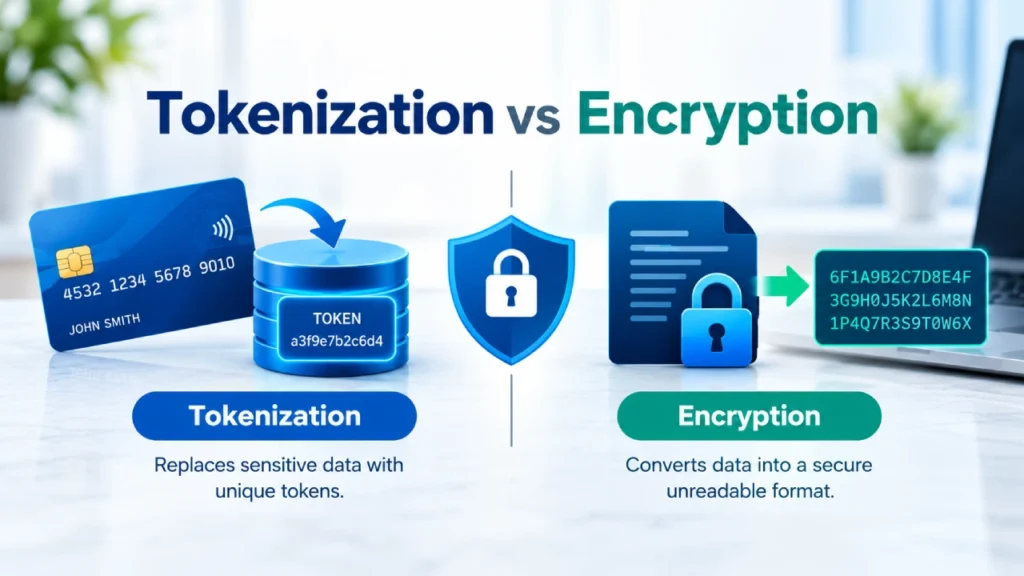
Tokenization and encryption both protect sensitive data, but they work in different ways. Encryption turns data into unreadable code that only the right decryption key can reverse. Tokenization swaps the data for a surrogate value, called a token, that has little or no value outside its permitted use. As more payments move online, businesses use both methods to keep card details safe.
What Is Tokenization in Data Security?
Tokenization is the process of replacing sensitive information, such as a credit card number, a Social Security number, or personal identity data, with a unique surrogate value called a token. The token is designed not to reveal the original data.
In vault-based tokenization, the original data is stored securely and linked to its token through a protected mapping. Vaultless implementations use other mechanisms, such as cryptographic techniques, to generate or recover tokens.
How Tokenization Works in Payments
- Data Entry: A customer enters a credit card number on an e-commerce checkout page or mobile app.
- Token Generation: The payment provider or tokenization service replaces the primary account number (PAN) with a token. Depending on the implementation, the original PAN may be stored in a secure vault or managed through another protected tokenization mechanism.
- Transaction Processing: When tokenization is implemented so that card details are sent directly to the payment provider, the merchant’s backend can avoid handling or storing the actual card number. The precise exposure depends on the integration.
- Authorization: The token service provider or payment processor validates the token and, where necessary, retrieves or securely maps it to the underlying card number through the appropriate tokenization infrastructure to facilitate authorization.
Provider-issued tokens may be restricted to a particular merchant, provider, or use case. Network payment tokens are issued under card-network tokenization systems and can support approved use cases across different merchant environments, subject to their domain controls and other restrictions.
What Is Encryption in Data Security?
Encryption is the process of converting readable data (plaintext) into an unreadable, scrambled format (ciphertext) using a mathematical algorithm and a digital key. Properly implemented encryption makes data unreadable without the required key, provided the cryptographic algorithms, key management, and surrounding systems remain secure.
Core States Protected
- Data at Rest: Information stored in databases, hard drives, or cloud storage, often secured with AES-256.
- Data in Transit: Information moving across networks or the internet, often secured with TLS, the successor to SSL.
- Data in Use: Information being actively processed in memory. Protection may involve access controls, isolated execution environments, confidential computing, or specialized techniques such as homomorphic encryption, depending on the application.
Primary Types of Encryption
- Symmetric Encryption: Uses a single shared key to both encrypt and decrypt data. It is fast and efficient, and AES is the best-known example.
- Asymmetric (Public-Key) Encryption: Uses a mathematically related pair of keys. A public key encrypts the data and a private key decrypts it.
Encryption in Digital Payments
During an online payment, TLS protects data transmitted between the customer’s browser and the payment endpoint. Encryption at rest can separately protect stored transaction data. The specific controls depend on the payment architecture, and sensitive authentication data such as CVVs remains subject to strict storage restrictions.
Key Differences: Tokenization vs. Encryption
| Feature | Tokenization | Encryption |
|---|---|---|
| How it transforms data | Replaces data with a surrogate token that does not reveal the original value. | Scrambles data using an algorithm and key. |
| Reversibility | The original value generally cannot be derived from the token alone; authorized detokenization or lookup may recover the original value. | Reversible with the correct decryption key. |
| Where data lives | In vault-based systems, original data is locked away in a central vault; vaultless systems use cryptographic techniques instead. | Data stays in place but is scrambled. |
| Compliance impact | Can reduce PCI DSS scope when implemented appropriately; does not eliminate all compliance obligations. | Encrypted data often remains inside compliance scope. |
Tokenization vs Encryption: Advantages and Limitations
Both tokenization and encryption have advantages and limitations in data security.
Advantages of Tokenization
- Enhanced Data Security: Properly designed tokens limit the exposure of original data, provided the token cannot be misused or readily mapped back to the original.
- Reduced PCI DSS Scope: Storing tokens instead of raw card data can significantly reduce a business’s compliance scope and simplify audits for standards like the Payment Card Industry Data Security Standard.
- Merchant and Usage Restrictions: Restrictions on where and how tokens can be used reduce the risk of misuse if a token is intercepted. The protection depends on the token type and implementation.
- User Experience: Tokens allow one-click checkouts and easy repeat transactions without forcing customers to re-enter sensitive details.
- Reduced Breach Impact: If merchant systems that hold only tokens are compromised, attackers obtain surrogate values rather than actual personally identifiable information (PII) or financial account data.
Limitations of Tokenization
- Centralized Vault Risk: In vault-based systems, security depends heavily on the vault. A vault compromise can expose the mapped data, especially if vault encryption and key controls are weak.
- Performance and Latency: Looking up original values over a remote network can introduce processing delays compared to local cryptographic methods.
- Infrastructure Overhead: Tokenization requires a high-availability vault, backup systems, and disaster recovery plans.
- Workflow and Analytics Friction: Analytics, cross-system queries, and database searches can break if tokens hide the underlying structure, so careful planning and middleware integration are needed.
- Not a Standalone Fix: Tokenization protects stored or transmitted values, but systems still need layered defenses, such as end-to-end encryption and strong authentication, to cover every attack route.
Advantages of Encryption
- Protection Against Unauthorized Access: Stolen or intercepted data, such as passwords, database files, or payment card numbers, stays unreadable without the correct decryption key.
- Confidentiality and Integrity in Transit: Modern TLS protects data in transit against unauthorized disclosure and tampering. It does not protect compromised endpoints or guarantee that data cannot be deleted or altered after transmission.
- Works on Any Kind of Data: Encryption covers files, emails, backups, databases, and messages. It does not depend on a separate vault or on the data being a card number.
- Speed at Scale: Symmetric algorithms such as AES run quickly, and many modern processors include built-in hardware support for them.
- Recognized by Standards and Regulators: PCI DSS lists strong cryptography with proper key management as an accepted way to make stored card numbers unreadable. The GDPR identifies encryption and pseudonymization as examples of appropriate technical and organizational security measures, selected according to the risks involved.
Limitations of Encryption
- Key Management Burden: The data is only as safe as its keys. Keys need secure generation, storage, rotation, and retirement, and a stolen key exposes everything it protects.
- Compliance Scope Stays: Encryption alone does not automatically remove cardholder data from PCI DSS scope. Whether a system can be excluded depends on its access to decryption keys and plaintext, its connectivity, and the applicable PCI DSS scoping criteria.
- Encrypted Data Remains Reversible: Copied encrypted data stays reversible with the right key, so attackers can attempt to break it later, especially if the algorithm or implementation is weak.
- Outdated Protocols: The PCI Security Standards Council does not consider SSL or early TLS to be strong cryptography, so older connections can fail a compliance review.
- Format and Performance Effects: Standard encryption changes the length and format of a value, which can break systems that expect a fixed field. Encrypting very large data sets also adds processing load.
Tokenization vs Encryption for Sensitive Data: Choosing the Right Approach
Neither method is better in every case. The choice depends on what the data needs to do after it is protected.
- Saving cards for repeat billing or click checkout: Tokenization.
- Protecting card data as it travels from browser to server: Encryption (TLS).
- Cutting the number of systems that fall under PCI DSS: Tokenization.
- Protecting files, backups, and databases that must be read back in full: Encryption.
- Letting staff and systems reference a card without seeing it: Tokenization.
- Securing emails, messages, and stored documents: Encryption.
Most payment setups use both. Encryption protects card data while it moves from the customer to the processor. Tokenization then replaces the card number in the merchant’s systems, and the vault behind it often relies on encryption too.
Best Practices for Using Tokenization and Encryption Together
Here are some of the best practices and methods for using Tokenization and Encryption together.
- Use current TLS for all payment pages: Retire SSL and early TLS versions with known weaknesses.
- Prefer random tokens: A token should have no formula linking it to the card number. Tokens derived from predictable data using unsalted or otherwise inadequate hashing may be vulnerable to guessing and correlation attacks.
- Lock down the vault: Place it in a separate network segment, limit access by role, and log every detokenization request.
- Manage keys with a documented process: Cover generation, storage, rotation, and retirement; keep keys in as few places as possible; and restrict who can access them.
- Check the provider’s compliance: When using a third-party tokenization service, review its Attestation of Compliance every year.
- Do not store the CVV after authorization: PCI DSS bars storing it even in encrypted form.
Tokenization and encryption solve different problems. Encryption keeps data unreadable without the right key, and tokenization removes sensitive data from everyday systems by substituting surrogate values. Check each provider’s implementation and one’s data flows against current PCI DSS requirements.
Frequently Asked Question
Encryption scrambles data so the matching key can restore it. Tokenization replaces data with a surrogate value that cannot be reversed to the original on its own.
Neither is better in every case. Tokenization reduces how much sensitive data a system holds, while encryption protects data from unauthorized disclosure.
A properly designed token should not reveal the original data by itself. Depending on the implementation, recovering the original may require an authorized vault lookup, a token service, or a protected cryptographic operation.
Encryption alone generally does not remove cardholder data from PCI DSS scope. In certain circumstances, a third party that receives or stores only properly encrypted data and cannot access the decryption keys or plaintext may qualify to treat that data as out of scope. The applicable conditions must be evaluated for the specific environment.
No, it can shrink the number of systems that need review, but the vault, the provider, and any system that handles real card numbers must still meet the standard.
Yes, and most do. Encryption protects data in transit and inside the vault, while tokens replace card numbers in everyday systems.
A token issued through a card-network system that can support approved uses across merchants, subject to restrictions. Gateway-issued tokens are often limited to a specific provider or merchant.

Join the conversation
Have something to add? Share your thoughts below.