


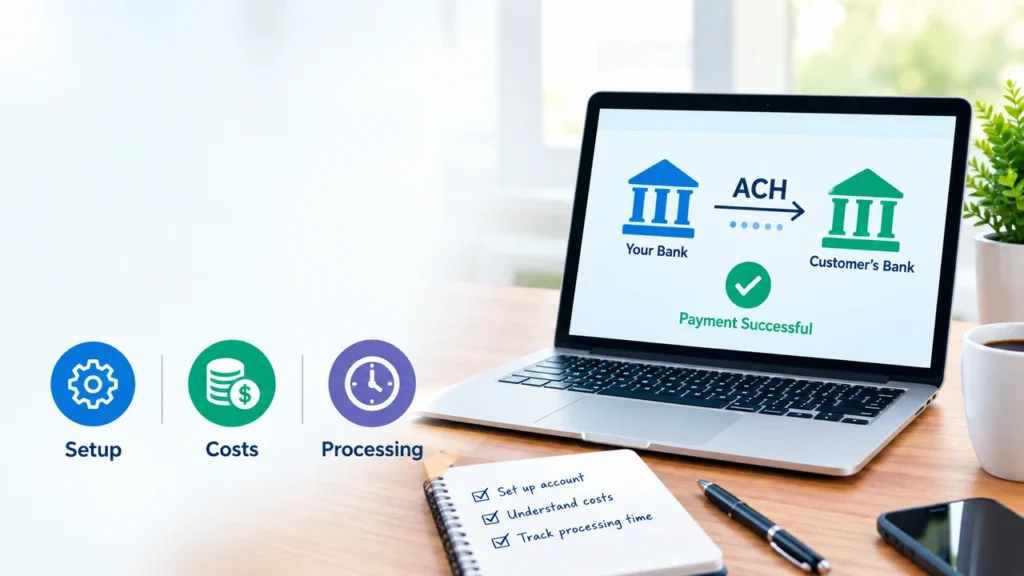
Accepting ACH payments gives businesses a faster, cheaper way to collect money directly from a customer’s bank account, skipping card networks entirely and moving funds straight between banks through the Automated Clearing House network. For businesses with recurring billing, high transaction volume, or large invoice amounts, this method often cuts costs significantly compared to card processing fees.
How ACH Payments Work
Every ACH transaction follows a structured path between the originator, the banks involved, and the ACH network.
1. Authorization
The process starts with authorization. A business cannot pull funds from a customer’s account without clear, documented permission. This can be a signed form, a typed agreement, or an online checkbox tied to the terms of service. This step protects both sides if a dispute comes up later.
2. Account Information Collection
Once authorization is in place, the business collects the customer’s routing number and account number. This information is what allows the transaction to be routed to the correct bank.
3. Transaction Submission
The business, or its payment processor, submits the transaction to its bank, known as the Originating Depository Financial Institution (ODFI). The ODFI bundles transactions into batches rather than sending them one at a time.
4. Processing Through the ACH Network
The batch is sent to an ACH operator, either the Federal Reserve or The Clearing House. The operator sorts the batch and routes each transaction to the correct Receiving Depository Financial Institution (RDFI), the customer’s bank.
5. Settlement
Finally, funds move between the banks and the transaction is marked complete. Standard ACH payments typically settle within one to three business days. Same Day ACH allows eligible transactions to settle the same day they are submitted, provided they are sent before the cutoff time.
Steps to Start Accepting ACH Payments
Setting up a reliable system for accepting ACH payments involves a few key stages.
1. Choose a Payment Processor or ACH Payment Gateway
A business needs an ACH payment gateway or processor to handle the technical side of transmitting transactions to the ACH network. Many processors bundle ACH processing alongside card payments, giving a single dashboard for both.
2. Set Up a Merchant Account
Most providers require a merchant account to route funds correctly. Some newer platforms skip this step by integrating ACH directly into a broader payments platform.
3. Build or Integrate an Authorization Process
Before any transaction goes through, the business needs a clear, documented method of getting customer consent. This might be a checkbox during checkout, a signed PDF, or a recorded verbal authorization for phone-based payments.
4. Collect Banking Details Securely
Routing and account numbers should be collected through encrypted, PCI-compliant systems. Storing this information insecurely creates real risk for both the business and the customer.
5. Submit and Monitor Transactions
Once live, the business submits payment requests through its chosen ACH payment processor. Most platforms show pending, settled, and failed transactions in a dashboard, making it easier to track cash flow.
Common Ways Businesses Accept ACH Payments
ACH payment methods vary depending on how a business operates:
- Recurring Payments: subscriptions, memberships, and installment plans often use standing ACH authorizations.
- Invoicing: B2B transactions frequently rely on ACH to avoid high card processing fees on large invoices.
- One-time online payments: checkout pages increasingly offer a “pay by bank” option alongside card payments.
- Phone or mail orders: some businesses still process ACH payments using a signed authorization form submitted by the customer.
How Fast Can a Business Accept ACH Payments?
Businesses sometimes search for ways to accept ACH payments instantly, but it helps to set accurate expectations. Standard ACH transactions still move through a batch process, so instant settlement in the literal sense is not how the network operates. What has changed is speed relative to older timelines:
- Standard ACH: Settles in one to three business days.
- Same Day ACH: Settles the same business day if submitted before the processor’s cutoff time.
Some payment platforms market “instant” or “real-time” options, but these typically rely on risk-based advances rather than true real-time bank settlement. A business evaluating providers should ask directly how “instant” funding actually works before relying on it.
Cost of Accepting ACH Payments
One of the biggest reasons businesses look for ways to accept ACH payments free or at low cost is the pricing structure compared to cards. ACH transactions are usually billed as:
- A flat fee per transaction, or
- A small percentage, often capped at a set maximum
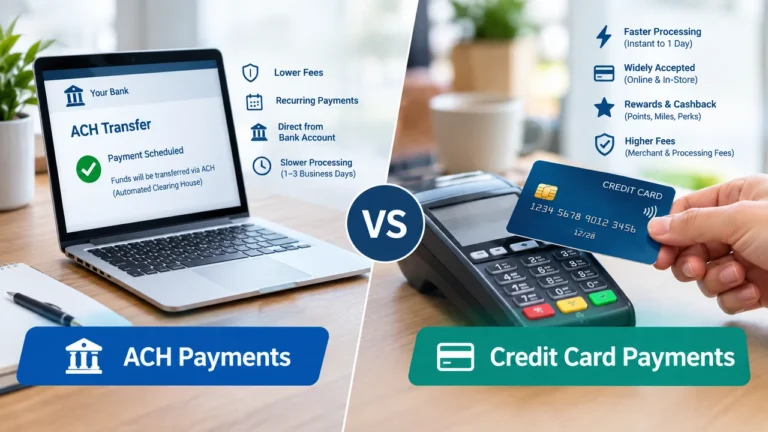
This structure makes ACH noticeably cheaper than card processing for high-value transactions, since card fees scale with transaction size without a cap in most cases.
Some processors advertise no setup fee or no monthly fee, which is where searches for a truly free entry point usually lead.
Accepting ACH Payments for Small Business
ACH payment processing for small businesses often comes bundled into existing invoicing or accounting software, making setup faster than building a standalone system. Many small business owners start by enabling ACH as a secondary option alongside card payments, then shift more customers toward it over time as the cost savings become clear on larger invoices.
Risks to Consider Before Accepting ACH Payments
ACH payments carry a different risk profile than card payments:
- No real-time verification: Unlike a card swipe, there’s no instant confirmation that funds exist.
- Returns can take days: A failed ACH debit (insufficient funds, closed account) may not be flagged for several days.
- Authorization matters: A business without proper, documented authorization has little protection if a customer disputes a charge.
Working with a processor that offers account verification tools can reduce the risk of failed transactions and costly returns.
Businesses that want to receive payments via ACH gain a lower-cost, reliable alternative to card processing, especially for recurring charges and large invoices. The setup requires a few deliberate steps: choosing a processor, confirming proper authorization, and collecting banking details securely. Once in place, ACH becomes a dependable backbone for predictable payment collection, and Same Day ACH options have reduced the speed gap.
Frequently Asked Questions
A business needs a payment processor with ACH capability, a documented authorization process, and a secure way to collect routing and account numbers.
Yes, most modern payment gateways support ACH as a checkout option alongside debit and credit card processing.
Standard ACH transactions settle in one to three business days. Same Day ACH can settle the same day if submitted before the processor’s cutoff time.
Some processors offer no setup or monthly fees, though per-transaction costs still apply. Comparing fee schedules closely is the best way to find a low-cost option.
Many industries use it, including subscription services, utility companies, B2B vendors, and property management companies collecting rent.
A payment processor or gateway, a merchant account (in most cases), a customer authorization process, and a secure system for handling bank account details.


Join the conversation
Have something to add? Share your thoughts below.