


A merchant account and a payment gateway solve two different problems in the same transaction. A payment gateway captures and encrypts a customer’s card details and sends them along for approval, while a merchant account is the actual bank account that holds the funds once a card payment has been approved. One moves the data. The other moves the money.
What Is a Merchant Account?
A merchant account is a specialized account used to receive funds from card transactions. It isn’t the same as a regular business checking account. Businesses that process cards through a traditional acquiring arrangement generally have a merchant account, while businesses using a payment facilitator may operate under the facilitator’s acquiring arrangement instead.
- When a customer’s card is charged, the money doesn’t go straight into the business’s checking account.
- The timing varies by provider and processing arrangement; funds may be settled and paid out according to a schedule ranging from same-day or next-day to several business days.
- This holding period exists partly for practical settlement reasons and partly as a buffer against disputes, refunds, and chargebacks.
Merchant accounts are set up through an acquiring bank, either directly or through a payment facilitator or ISO. Approval usually involves underwriting based on the business’s risk profile, industry, processing history, and expected volume. Higher-risk or new businesses may face higher fees, reserves, or stricter approval requirements.
What Is a Payment Gateway?
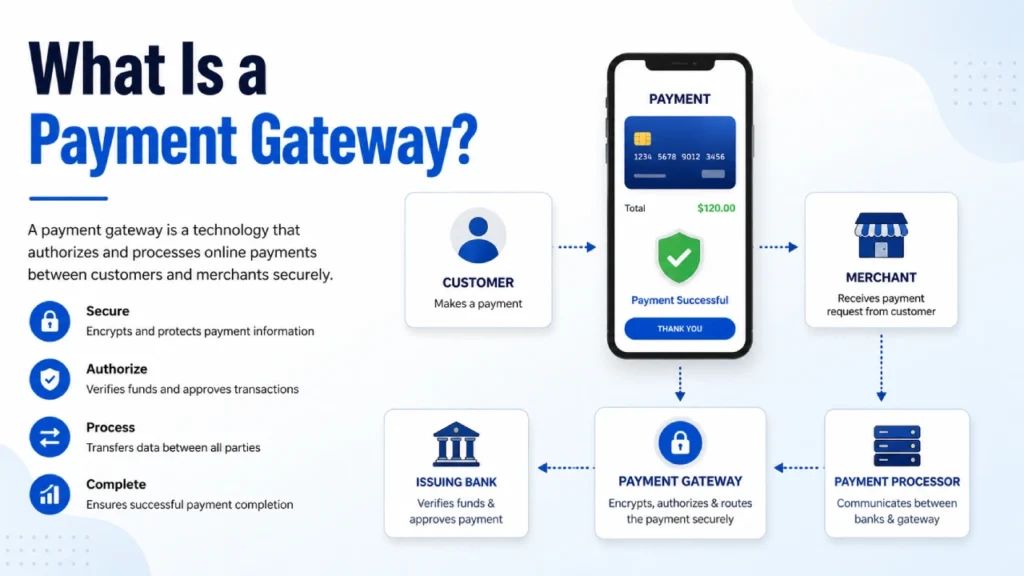
A payment gateway is the technology that captures a customer’s payment details and transmits them securely to the processor and card network for authorization. Acting as a physical card reader, it takes the raw card information, encrypts it, and asks whether the transaction should be approved or declined based on available funds, fraud signals, and account status.
- For online transactions, the gateway is usually invisible to the customer, running behind a checkout page, embedded form, or a payment page.
- For in-person transactions, it is often built into the card terminal itself, though the same basic job is being done: capturing card data and requesting authorization.
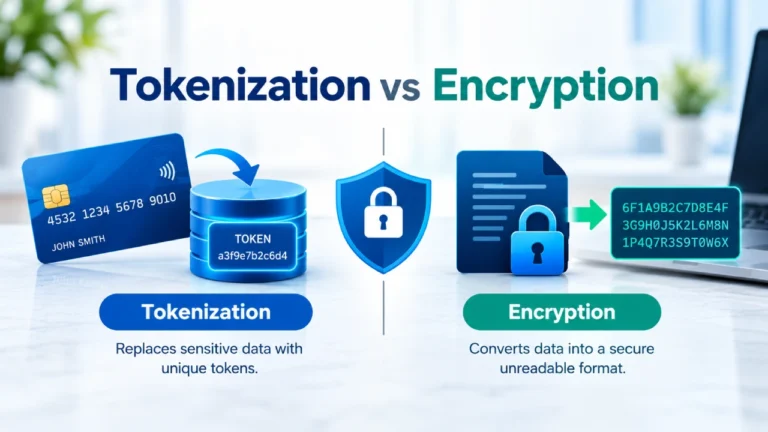
Gateways also typically add a layer of security and fraud protection on top of the basic authorization request. This can include tokenization, which replaces sensitive card numbers with a randomized stand-in value so the business’s own systems never store the actual card number, along with fraud-scoring tools that flag suspicious transactions before they’re approved.
How They Work Together in a Single Transaction
A single card payment moves through several steps, and both the gateway and the merchant account play a role at different points:
- A customer enters card details, either online through a checkout form or in person via a terminal.
- The payment gateway captures and encrypts that information, then sends an authorization request to the payment processor.
- The processor routes the request through the relevant card network (Visa, Mastercard, Discover, or American Express) to the customer’s issuing bank.
- The issuing bank approves or declines the transaction based on available funds and fraud checks, and sends that response back through the same chain.
- The gateway relays the approval or decline back to the checkout page or terminal, typically within a few seconds.
- On approved transactions, funds are later settled into the business’s merchant account, usually in a batch at the end of the business day, before transferring to the business’s regular bank account after a short holding period.
The gateway is only involved in the front end of this process, the part that happens in real time as the transaction is authorized. The merchant account picks up after that, holding and eventually releasing the actual funds.
NOTE: Many providers, including a lot of small business payment platforms, package both functions together under one product, which is part of why the distinction gets blurry for business owners setting things up for the first time.
Merchant Account vs Payment Gateway
| Basis | Merchant Account | Payment Gateway |
|---|---|---|
| What it does | Holds and settles funds from card transactions. | Captures and transmits card data for authorization. |
| Where it is | Between the acquiring bank and the business’s regular bank account. | On the payment-data and authorization side. |
| Involves funds directly | Yes, temporarily holds settled funds. | No, only relays authorization data. |
| Set up through | An acquiring bank, ISO, or payment facilitator | A gateway provider, often bundled with a processor. |
| Primary risk factor | Underwriting, chargebacks, reserve requirements. | Data security, fraud prevention, uptime. |
| Required for | Receiving settled funds from card payments. | Authorizing card payments in real time. |
Does a Business Need Both Merchant Account and Payment Gateway?
Most card payments involve gateway functionality for securely transmitting payment data and an acquiring arrangement for receiving settled funds. However, businesses using a payment facilitator may not have their own dedicated merchant account.
- Payment facilitators, sometimes called PayFacs, aggregate many small businesses under one larger master merchant account rather than requiring each business to go through individual underwriting.
- Providers work this way for most small accounts, combining gateway and merchant account functions into a single sign-up process with fast approval and simple, flat-rate pricing.
- This setup trades some cost efficiency and account-level control for speed and simplicity, which suits many small businesses just getting started.
A merchant account, set up directly or through an ISO, separates the gateway and account relationship, which usually means a more involved application process but often lower effective processing costs at higher volumes, along with more control over underwriting terms, reserve requirements, and dispute handling. This route tends to make more sense once a business is processing a meaningful, consistent volume each month, since the savings from interchange-plus pricing start to outweigh the extra setup effort.
Common Misconceptions About Merchant Accounts and Payment Gateways
Generally, business owners misinterpret statements about merchant accounts and payment gateways.
1. A payment gateway is just for online stores.
Gateways are also used in physical retail, even if the term isn’t always visible to the business owner. Card terminals still need to transmit data somewhere for authorization, and that function is a gateway even when it’s built directly into the hardware.
2. A merchant account is the same as a business bank account.
It isn’t. A merchant account is a specialized intermediary account tied to debit or credit card processing, and funds don’t stay there long-term. Regular operating funds still live in the business’s standard checking account.
3. Switching gateways means switching merchant accounts too, or vice versa.
Depending on the setup, these can sometimes be changed independently. Some providers allow a business to keep its merchant account while changing gateway software, and some gateways support connections to multiple merchant accounts. This depends heavily on the specific providers involved, so it’s best to confirm before assuming a switch requires rebuilding the whole setup.
4. An all-in-one provider is always cheaper.
For low-volume businesses, flat-rate, all-in-one pricing is often the simpler and cheaper option. At higher volumes, however, a separate merchant account with interchange-plus pricing frequently comes out ahead, since flat-rate pricing charges the same rate regardless of card type, which can overcharge for lower-cost debit transactions.
Costs and Fees for Merchant Account vs Payment Gateway
Both components carry their own cost structure, and the split isn’t always on a combined statement.
- Gateway costs typically include a monthly or per-transaction fee, sometimes both. Standalone gateway fees commonly run somewhere in the range of $5 to $30 per month, plus a small per-transaction charge, though many all-in-one providers fold this into their overall processing rate rather than billing it separately.
- Merchant account costs are more layered. These typically include the underlying interchange fees set by the card networks (non-negotiable and passed through at cost by most providers), assessment fees charged by the network itself, and a markup added by the acquiring bank or ISO, which is the primary negotiable piece of the total cost. Additional charges can include monthly account fees, PCI compliance fees, chargeback fees, and in some cases a reserve requirement, where a percentage of processed funds is held back temporarily as a buffer against disputes.
- For a business comparing options, the most reliable way to evaluate cost isn’t the advertised headline rate on either the gateway or the merchant account individually, but the total effective rate: total fees paid divided by total volume processed, across a representative month.
Choosing Between an All-in-One Provider and Separate Components
A few factors can affect the decision of choosing between the all-in-one provider and separate components.
- Monthly processing volume: Lower-volume businesses generally do better with an all-in-one provider’s flat-rate simplicity. Higher-volume businesses more often benefit from a dedicated merchant account with interchange-plus pricing.
- Technical setup needs: Businesses building a custom checkout flow or integrating payments into existing software often need a standalone gateway with a flexible API, separate from whichever merchant account holds the funds.
- Industry risk category: Certain industries face more scrutiny during merchant account underwriting, and an aggregated payment facilitator account can sometimes be easier to get approved for, though it may come with lower transaction caps or more frequent account reviews as a tradeoff.
- Need for dispute and chargeback control: A merchant account generally offers more direct visibility and control on dispute management, compared to the more standardized dispute process built into an all-in-one platform.
- Growth track: A business expecting rapid volume growth may be better served starting with, or planning a future move to, a merchant account, since renegotiating pricing becomes more difficult as volume increases.
Conclusion
A merchant account and a payment gateway aren’t competing options; they’re two different links in the same chain that moves money from a customer’s card to a business’s bank account. The gateway handles the real-time authorization and data security side of a transaction, while the merchant account handles the settlement and holding of actual funds. Understanding which provider is responsible for which function makes it much easier to evaluate pricing, troubleshoot a processing issue, or plan a move from an all-in-one platform to a more customized setup as a business grows.
Frequently Asked Questions
Yes, a payment gateway and a merchant account are different, but they work together to process online card payments.
In some cases, yes. Certain gateways support connecting to a separate, dedicated merchant account rather than requiring a bundled account through the same provider. This depends on the specific gateway and acquiring bank involved.
The brief holding period allows time for standard settlement processing and provides a buffer against potential disputes or chargebacks before funds are fully released to the business’s regular bank account.
Not necessarily. Many small businesses operate effectively with an all-in-one provider that bundles gateway and merchant account functions, only moving to a dedicated account once volume grows enough to make the switch cost-effective.
Gateways typically charge a monthly platform fee plus a small per-transaction fee for the authorization service. Merchant accounts carry interchange and assessment fees, a processor markup, and sometimes account-level fees like monthly minimums or PCI compliance charges.
Reputable gateways generally avoid storing raw card numbers directly, instead using tokenization to replace the card number with a randomized value for any future reference, which reduces the compliance burden and risk for the business using the gateway.
Sometimes. If the gateway in use supports multiple merchant account connections, a business can often switch the underlying merchant account while keeping the same checkout or terminal setup. This isn’t universal, so confirming compatibility with the current gateway provider before switching is a necessary step.

Join the conversation
Have something to add? Share your thoughts below.